Published on 02 February 2026 by CareerDec
On February 1, 2026, Finance Minister Nirmala Sitharaman presented the Union Budget 2026-2027 to Parliament in a landmark budgetary presentation for the ninth straight year. She became the nation's first female Finance Minister when she presented the Central Budget for the ninth time in a row. This budget is not merely a compilation of data, but is considered a roadmap that will chart a new route for India's economy.
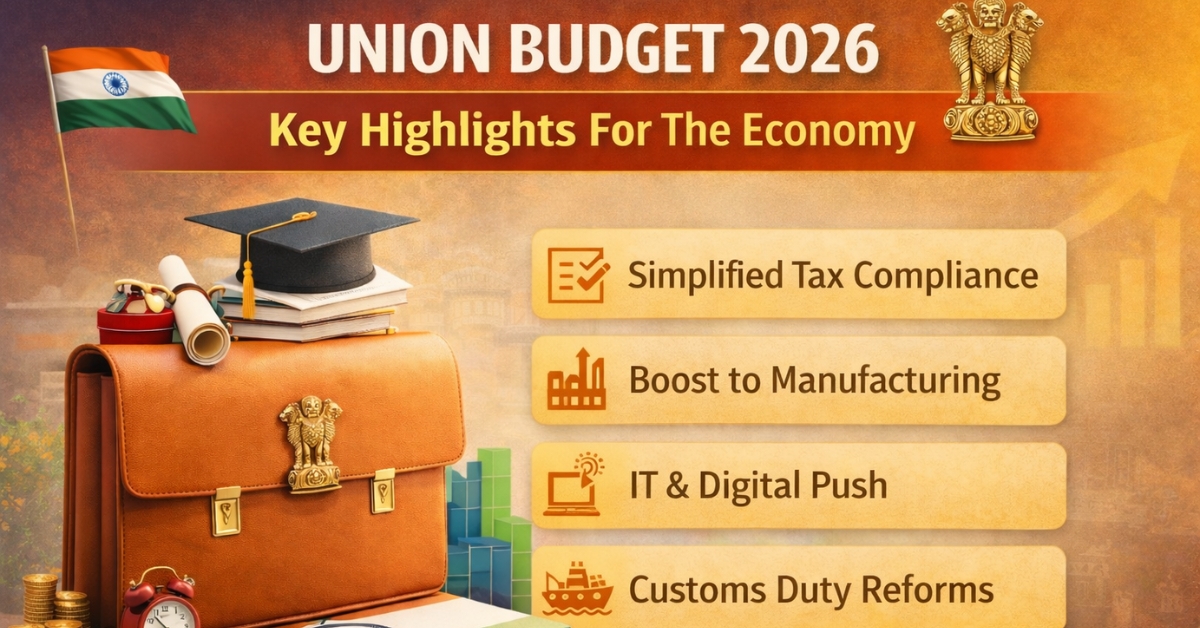
As part of its budget, the government has continued to prioritise capital expenditures, manufacturing competitiveness, and infrastructure development. Part B of the Union Budget 2026-27 highlights tax reforms and tax administrations, including direct and indirect taxes that influence ease of living for common people. Read on.
Major Announcements In Direct Tax Administration By Budget 2026

- A new and simplified Income Tax Rules and Forms will be released soon. The ITR forms have been redesigned to make it easier for common people to comply. The New Income Tax Act 2025 is going to come into effect from April 2026.
- Interest granted by the Motor Accident Claims Tribunal to a natural person will not be subject to income tax, and any TDS on this account will be eliminated. Simplified TDS regulations for staff supply will benefit labour-intensive firms.
- Small taxpayers can receive a lower or zero deduction certificate through a rule-based automated method rather than submitting an application to the assessor.
- Single window filing with depositories for Form 15G or 15 H for TDS on dividends, interests, etc.
- Extend the deadline for amending returns from December 31 to March 31 in exchange for small payments.
- PAN-based challans for local buyers will take the place of TAN in real estate transactions involving NRIs.
- Small taxpayers can report their foreign assets or income through a one-time, six-month foreign asset disclosure program.
- IT evaluation & penalty proceedings are planned to be merged by way of a common order for both.
- Even after reassessment procedures have been started to lessen litigation, taxpayers are permitted to amend their returns at an extra 10% tax rate above the appropriate rate for the relevant year.
- If additional income tax is paid, the penalty for misreporting income is also eligible for immunity.
- Decriminalisation of non-production of books of account and documentation, as well as the requirement of TDS payment when payment is made in kind.
- Immunity from prosecution will be granted for non-disclosure of non-immovable foreign assets with a total worth of less than 20 lakh rupees, starting on October 1, 2024.
- Extend the deduction previously granted to a primary cooperative organisation involved in supplying milk, oilseeds, fruits or vegetables raised or farmed by its members to those supplying cattle feed and cottonseed likewise.
- Under the new tax system, allow the inter-cooperative society to deduct dividend income to the amount that it is allocated to its members.
- Software development services, IT-enabled services, knowledge process outsourcing services, and contract R&D services of software development will be combined under a single category of Information Technology Services with a uniform safe harbour margin of 15.5%.
- The threshold for availing safe harbour for IT services has been lifted from 300 crore rupees to 2,000 crore rupees.
- Safe harbour for IT services shall be granted by an automated rule-driven process, which can be continued for a duration of 5 years at a stretch.
- The unilateral Advanced Pricing Agreement (APA) procedure for IT services will be expedited with the goal of completing it in two years, with a six-month extension available upon request from the taxpayer. The entity entering APA will be allowed to extend the modified return facility to its affiliated entities.
- Any foreign business that uses Indian data centre facilities to offer cloud services to clients worldwide would be granted a tax exemption through 2047.
- If the business offering data centre services from India is a linked firm, a safe harbour of 15% on costs will be granted.
- a safe harbour for non-residents to store components in a bonded warehouse with a 2% profit margin on the invoice amount. Compared to comparable jurisdictions, the resulting tax of roughly 0.7% will be significantly cheaper.
- Any non-resident who supplies capital goods, machinery, or tools to any toll maker in a bonded zone will be exempt from income tax for five years.
- To incorporate the requirements of the Income Computation and Disclosure Standards (ICDS) into the Indian Accounting Standards (IndAS), a Joint Committee of the Ministry of Corporate Affairs and the Central Board of Direct Taxes will be established. The ICDS-based separate accounting requirement will be eliminated starting in the 2027–2028 tax year.
- In the benefit of minority shareholders, repurchases for all categories of shareholders are to be taxed as Capital Gains. The additional buyback tax that promoters must pay will result in an effective tax of 22% for corporate promoters and 30% for non-business promoters.
- The TCS (Tax Collected at Source) rate for tendu leaves will be lowered from 5% to 2%, and it will be rationalised to 2% for sellers of particular items, such as alcoholic liquor, scrap and minerals.
- STT on Futures to be hiked to 0.05% from the present 0.02%. The current rates of 0.1% and 0.125%, respectively, will be increased to 0.15% for STT on options premiums and option exercises.
- Set-off of brought forward MAT (Minimum Alternate Tax) credit will only be permitted to businesses operating under the new framework to incentivise businesses to switch. Set-off using available MAT credit to be granted to an amount of 1/4th of the tax liability in the new regime.
- It is suggested that MAT become the last tax. On April 1st, 2026, there will be no more credit accumulation. The present MAT rate of 15% will be lowered to 14% as the final tax rate.
Major Announcements In Indirect Tax Administration By Budget 2026
- The present duty-free import cap of 1% will be raised to 3% of the FOB value for certain inputs used in the processing of seafood products for export.
- Exports of leather or synthetic footwear are currently eligible for duty-free imports of specific inputs.
- The basic exemption from customs duties granted to capital items used in the production of lithium-ion batteries will be extended.
- The basic customs duty on the import of sodium antimonate for use in the manufacture of solar glass must be exempted.
- Until 2035, imports of goods necessary for nuclear power projects will be exempt from basic customs duties.
- The fundamental customs duty on the import of capital items necessary for the processing of key minerals is to be exempted.
- The total value of biogas for the purpose of calculating the Central Excise duty due on biogas-mixed CNG shall be excluded.
- Basic customs duty will be waived for parts and components needed to produce civilian, training, and other aircraft.
- The basic customs duty on raw materials imported for the fabrication of parts of aircraft to be utilised in maintenance, repair, or overhaul required by Units in the Defence sector is to be waived.
- The basic customs duty will not apply to some parts used in the production of microwave ovens.
- The tariff rates on all dutiable products imported for personal use should be cut from 20% to 10%.
- To enable sales by qualified industrial facilities in Special Economic Zones (SEZs) to the Domestic Tariff Area (DTA) at reduced duty rates, a unique one-time approach is suggested. The number of such sales will be limited to a defined fraction of their exports.
- 17 pharmaceuticals and medications are exempt from the baseline customs charge.
- Duty-free personal import of drugs/ medications and food for 7 additional uncommon disorders.
- Custom procedures should involve as little involvement as possible to facilitate the quicker and more efficient flow of goods.
- The 15-day duty deferral period for Tier 2 and Tier 3 Authorised Economic Operators (AEOs) will be extended to 30 days. The same is offered to the eligible manufacturer-importers.
- The Customs warehousing framework must be turned into a warehouse operator-centric system with self-declarations, computerised tracking and risk-based audit.
- Cargo clearance approvals from numerous Government departments are to be smoothly completed through a single and interconnected digital window before the end of the financial year.
- Processes involved in the clearance of food, pharmaceuticals, plant, animal, and wildlife goods, accounting for about 70% of interdicted cargo, should be operationalised on this system by April 2026.
- Customs will pass goods without any compliance requirements as soon as the importer completes their online registration.
- Customs Integrated System to be built out in 2 years as a single, integrated and scalable platform for all the customs processes.
- Utilisation of non-intrusive scanning with advanced imaging and AI technologies for risk assessment is to be increased in a stepwise way, with the target to scan every cargo across all the major ports.
- Fish caught by an Indian fishing vessel in the Exclusive Economic Zone (EEZ) or on the High Seas would be free of duty, but if the fish is landed at a foreign port, it will be considered an export.
- The goals of India's small companies, craftsmen, and start-ups to access international markets through e-commerce are supported by the full removal of the current value cap of ₹10 lakh per consignment for courier exports.
- Rules about baggage clearance will be updated while travelling abroad. The budget suggests revising regulations to improve duty-free allowances in accordance with current travel conditions.